
 3 years ago
1
3 years ago
1
ARTICLE AD BOX
Global management consultancy Kearney has published the findings of its 2022 Global Cities Report, analysing the performance of 156 cities across the globe and how they have been impacted by higher-than-expected global inflation, climate-related hazards, and investments they are making in their futures.
The report utilises the Global Cities Index (GCI) as the picture of the present standing while using the Global Cities Outlook (GCO) as a forecast for the future.
The rankings measure cities by their ability to attract and retain global capital, people, and ideas and to sustain this performance in the long term.
Globally, cities were impacted by higher-than-expected inflation worldwide, the ongoing economic and political repercussions of the conflict in Ukraine, and the escalating effects of climate change, manifesting in calamities such as extreme heat, droughts, and increasingly intense storm activity.
These harsh realities of 2022 affected all cities globally, but some weathered the storms better than others.
Ultimately, cities that were more resilient in the face of these challenges and better adapted to the changing circumstances ranked higher.
The report also provides recommendations that cities could follow to adapt successfully and pre-emptively respond to the challenging economic conditions.
Out of the 13 African cities included in the study, Johannesburg remained the highest ranking in 58th place – despite dropping by three positions compared to 2021. The report showed that Cape Town, which ranked 81st last year, climbed by one spot and now ranks 80th.
The outlook for both cities remains negative, with the report placing Joburg and Cape Town in the bottom 50 in the ranking. Both cities’ prospects remained unchanged – ranking 122nd and 126th, respectively, the same positions recorded in 2021.
Kearney’s outlook report highlights hyperinflation’s strong knock-on effects on the future viability of a global city.
Reflecting the overwhelming impact of the rising costs of living, retention of human capital, and access to innovation metrics are the most significant predictors of change in overall scores and rankings as entrepreneurs and creators consider moving out of the largest (and costliest) urban centres, it said.
Global performance
Despite economic headwinds constricting many cities in this year’s results, the top cities demonstrated unparalleled resilience.
Kearney said that New York, London, Paris, and Tokyo retained the top four positions in the index – becoming seemingly entrenched, holding these positions for the sixth consecutive year by demonstrating the robustness of their diversity of global strengths.
There were changes at the top of the index, however. Beijing broke into the top five trading places with this year’s sixth-place city, Los Angeles, due to its growth in information exchange and political engagement scores.
“In the coming year, we expect a major flux among global city rankings as policymakers and decision-making takes centre stage for 2023,” the group said.
“City leaders have a daunting task with an outsized role – positive or negative – in determining how the residents of their cities weather the anticipated economic storm ahead. In such volatility and uncertainty, prudent decision-making is more important than ever.
“The past two years of necessary, but frequently reactive, policymaking has shown that well-intentioned policies can lead to painful after-effects. Simply solving the immediate problem can worsen existing challenges in the medium term or create new issues altogether.”
Best Global Cities
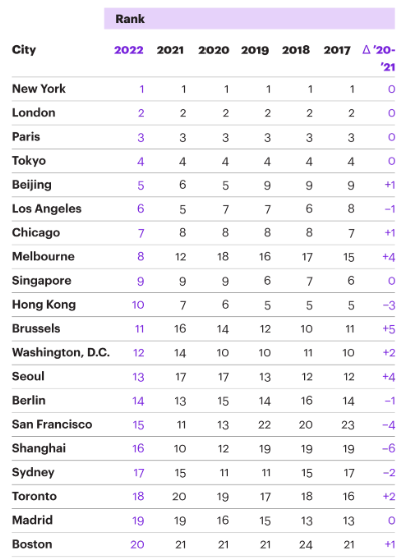


The best global cities are ranked on 29 metrics across five categories, including business activity (capital flow, market dynamics, major companies), human capital (education levels), information exchange (access to information, internet and media), cultural experience (sport, museums and expos), and political engagement (political events, think tanks and embassies).
Global Cities Outlook



The global cities outlook is based on 13 indicators across four categories, including personal well-being (safety, healthcare, inequality and environment), economics (long-term investments and GDP), innovation (entrepreneurship, private investments and incubators), and governance (stability, transparency, bureaucracy and ease of doing business).
Recommendations to adapt successfully
The report highlights ways cities can address the challenges they share in building resilience ahead of economic turbulence. Five strategic steps are imperative for cities leaders to consider:
Increase revenue and equity with targeted non-tax revenue
- Non-tax revenue, such as fines and fees, varies from place to place, but it tends to account for roughly 20 to 30% of city revenue.
- Cities are vested in enforcing and collecting these revenues in light of overly tight budgets, but this needs to be done without setting high rates to encourage evasion.
- Cities should look at target pricing mechanisms for non-tax revenue sources as they are typically flat and assessed without consideration for an individual’s ability to pay. They are, therefore, often profoundly regressive. A targeted mechanism known as segmented pricing enables the government to recognise the variation in individuals’ discretionary income and adjust penalties, fines, and fees considering their ability to pay.
Expand access to capital with aggregated platforms
- Tighter global monetary conditions and growing financial market instability will continue to raise the cost of municipal borrowing—a significant source of funding for cities, especially for infrastructure requirements.
- Cities should, therefore, look into the classic investment strategy of pooling and diversification—in this case, with an aggregated platform. Aggregated platforms allow cities to secure funding for infrastructure projects by improving their ability to access global capital at lower borrowing rates.
Tap carbon as an alternative revenue stream to fund green infrastructure
Climate change is definitively the challenge of our time.
- Carbon markets increasingly offer an alternative potential revenue stream for cities.
- Cities can build infrastructure that reduces carbon emissions, creating the opportunity to sell carbon credits to high-carbon-emitting companies that must purchase carbon credits to meet emissions targets, which finances further green infrastructure projects.
Protect the most economically vulnerable with targeted guaranteed-income programs
- In light of elevated unemployment numbers globally, cities can provide direct monetary support over a specified period, offering a way to cushion lower-income city residents.
- Targeted guaranteed income is distinct from universal basic income due to its narrow focus on those most in need, providing monetary relief to specific, thoroughly vetted individuals, families, or community segments.
Reform intra-city transit with universal basic mobility
- Energy price inflation impacts all citizens but disproportionately affects lower-income residents with the longest commutes.
- Cites can consider universal basic-mobility programs that provide a minimum level of transport accessible to all members of society or subsidise public transit for residents.
Read: The ugly truth lurking inside South Africa’s latest jobs data




 English (US)