
 3 years ago
2
3 years ago
2
ARTICLE AD BOX
South Africa is the 39th most air-polluted country in the world, with nearly five times the amount of pollutants recommended by World Health Organisation (WHO) guidelines, according to research platform IQAir.
“In addition to the frustration caused by load shedding, this points to the need for all South Africans to play our part in reducing our environmental impact and improving air quality, beginning by transitioning to alternative energy solutions,” says Alumo Energy Managing Director Rein Snoeck Henkemans.
 Alumo Energy Managing Director – Rein Snoeck Henkemans
“Energy generation is the single largest contributor to worldwide air pollution, especially fossil fuel reliant solutions.”
“Although Eskom employs a combination of power generation methods, the country remains largely dependent on thermal power stations which burn fuel to generate steam – giving households another compelling reason to reduce their reliance on the national grid.”
Notably, clean energy sources such as solar power do not produce greenhouse gasses.
Solar solutions utilise renewable energy in the form of sunlight – a natural resource that cannot be depleted and that replenishes quickly.
But as with any other investment, it’s important to do your homework and choose a provider you can trust to ensure that you receive the full benefit of your investment.
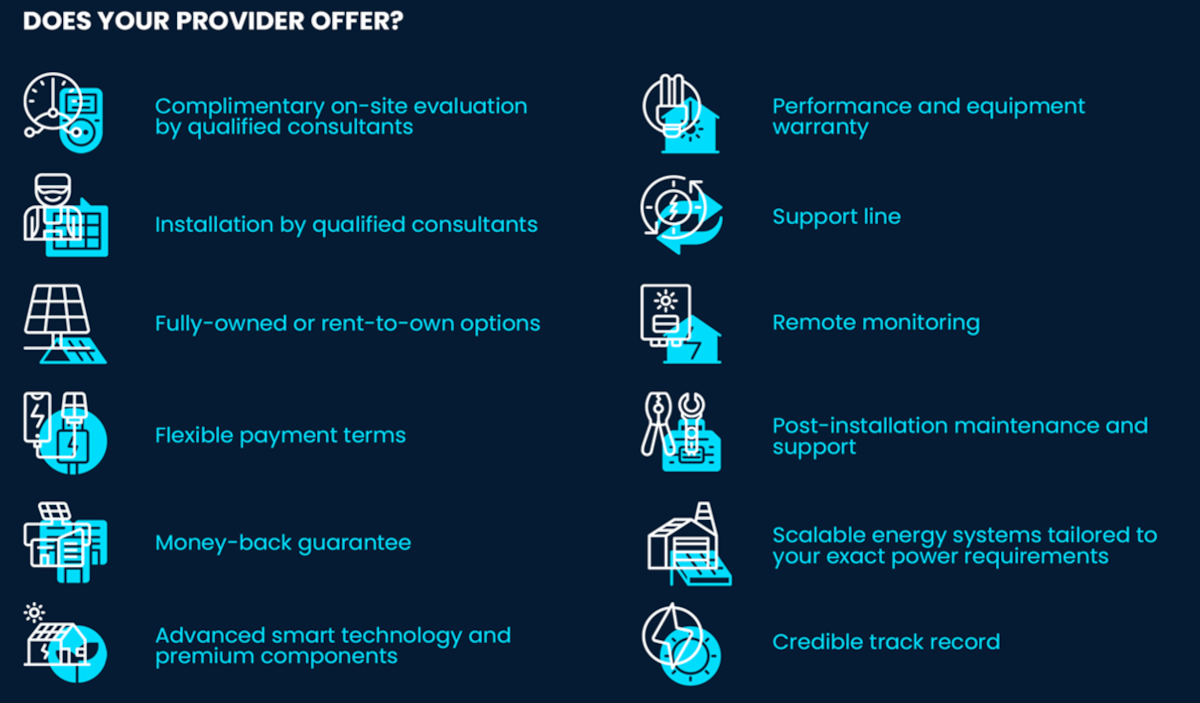
Before appointing a solar provider, Snoeck Henkemans therefore offers a definitive checklist for comparing suppliers:
1 – Complimentary on-site evaluation by qualified consultants
Before undergoing installation, check whether your provider offers a free on-site evaluation based on your needs.
Your consultant should help you to make an informed decision that is best suited for your home and budget.
2 – Installation by certified technicians
Ensure that you appoint a trained, experienced and accredited technician who will meet relevant regulations, as well as provide post-installation support.
These accreditations include being registered at the Electrical Contractors Association of South Africa (ECA) or the Electrical Conformance Board.
Along with being PV Greencard certified, the installer should also issue a Certificate of Compliance (COC) for the installation.
3 – Fully owned or rent-with-the-option-to-own payment terms
Trusted solar installers can provide you with various payment options to fit your financial needs.
For instance, systems can be purchased outright with a once-off payment.
Alternatively, some offer rent-to-own options, with a limited up-front capital investment and monthly instalments thereafter.
Both options should include post-installation support and access to maintenance, and allow for future expansion, enabling customers to start small and scale over time.
You could also possibly be offered a subscription model where you pay a lower fee, but the system never changes ownership.
Read the terms and conditions of these agreements very carefully, especially for specified charges should you cancel the subscription.
4 – Owning future benefits of the system
Municipal and national regulations for residential solar PV are being implemented with increased urgency, and require consumers to register their systems with the relevant authority.
This will bring about an additional monthly fixed fee charge, but a big reduction in cost per unit that you use from the grid.
Additionally, this will give you the ability to sell back to the grid, drastically improving your return on investment.
Ensure that you will own the future feed-in tariffs, rebates or any other green energy incentives earned by your system.

5 – All costs involved disclosed
Ensure that all costs are specified before signing an agreement, including costs for the complete installed system, specified removal or moving fees, and buy-out costs.
Be vigilant that you receive the full agreement and not only parts with reference made to others, as this is where the adverse clauses are hidden.
Installers charging a high upfront deposit should be thoroughly researched to ensure that your deposit is guaranteed.
6 – A money-back guarantee and equipment warranty
A trusted service provider includes a long-term warranty on all solar solutions, and offers a money-back guarantee.
Written terms and conditions on guarantees should be extensive and specific, outlining both parties’ rights and options.
7 – Advanced smart technology and premium components
Solar is an ever-evolving and advancing industry, which is why you should check that your solar provider is using the latest in advanced smart technology.
Given the size of your investment, ensure that your solution can supply you with your required electricity output when needed.
8 – Post-installation maintenance and support
Quality solar providers and installers include the option of annual on-site inspections, together with remote monitoring, post-installation maintenance, and professional technical support.
Check whether your provider has a support line, and that someone will be available to visit your home to resolve or repair any issues.
9 – Scalable energy systems tailored to your exact power requirements
Households have different, specific energy requirements, which means that each house needs a different solution.
A quick and easy way to determine what would work for you is to take Alumo’s instant online solar survey.
A household with a current on-grid electricity bill of R2,000 a month might need a 5kW inverter, 3.6kWh battery, and six solar panels for three-hour use.
This translates to R700 to R800 in electricity savings each month with a monthly rental fee of about R1800.
By contrast, a household with a R7,000 monthly bill might need an 8.8kW inverter, 5kWh battery, and 16 solar panels, resulting in roughly R2,500 in savings each month at a monthly rental price of about R2900.
You will also want to ensure that your chosen solar solution is scalable, enabling you to expand the system as your needs grow.
10 – A credible track record
Highly regarded and trusted solar providers and installers will have customer testimonials at the ready, positive reviews online, and examples of work done.
Ultimately, appointing the right solar supplier will save you money in the long run, giving you access to expert advice, support, and regular maintenance, and ensuring that your system functions correctly for years to come.
Click here to learn more about Alumo Energy.





 English (US)